🚨 From Accident to Awareness: What Global Buyers Must Know About Playground Safety in 2026
A Manufacturer’s Perspective from China
When Entertainment Turns Dangerous
In early February 2026, a serious accident occurred at a public fair in Faridabad, India, during the Surajkund International Crafts Mela.
A giant pendulum-style swing ride collapsed mid-operation, killing one police officer and injuring more than a dozen visitors.
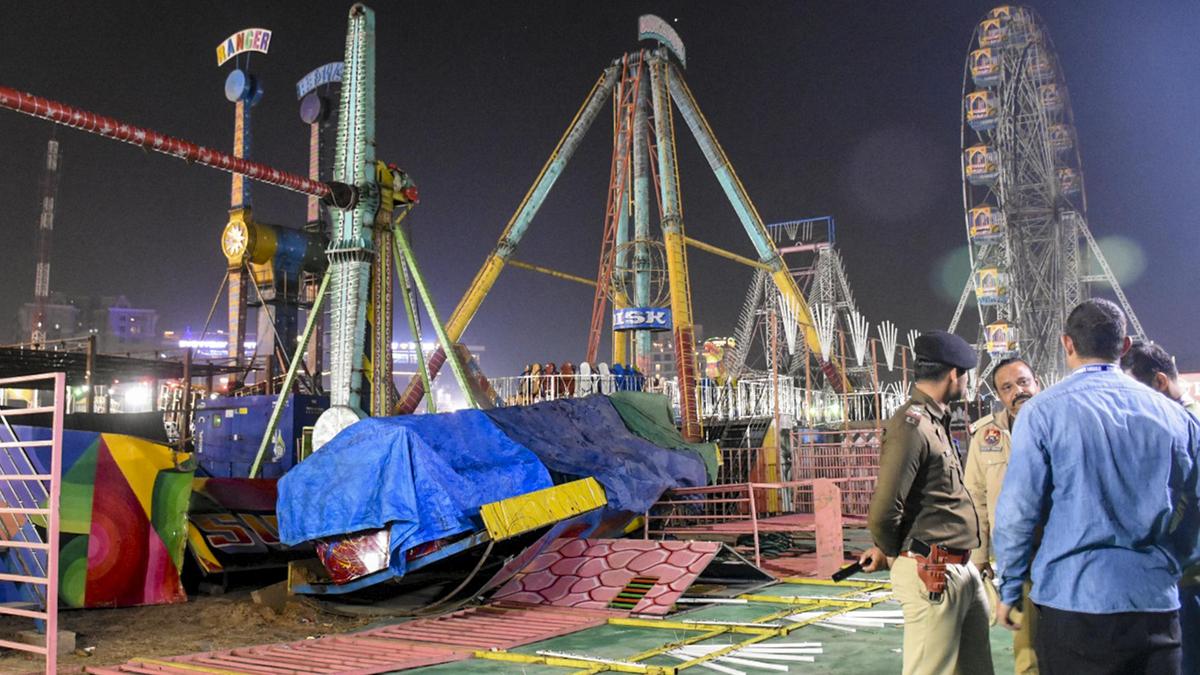
Major international media confirmed the incident:
Authorities stated the inspector died while attempting to assist in rescue operations.
This tragic event quickly circulated across global news platforms.
But beyond the headlines, it highlights a deeper issue that mall developers, family entertainment center (FEC) investors, and playground buyers must understand:
Not all “play equipment” follows the same engineering logic.
As a China-based indoor playground manufacturer with over 15 years of export experience, we believe this moment should be used for industry education — not sensationalism.
Temporary Amusement Rides vs Commercial Indoor Play Structures
(They Are NOT the Same Category)
The accident involved a high-speed mechanical swing ride, characterized by:
Dynamic centrifugal forces
Heavy moving masses
Repeated fatigue cycles
Temporary foundations
Outdoor exposure
Minimal redundancy
These systems behave like industrial machinery, not architectural structures.
Professional indoor playground systems, however, are designed as:
✅ Fixed commercial structures
✅ Static-load steel frameworks
✅ Distributed weight zones
✅ Multi-point anchoring
✅ Indoor-controlled environments
✅ Modular but permanent installations
From an engineering standpoint, indoor playgrounds are closer to light steel buildings than amusement rides.
Yet many buyers still group everything under “playground equipment.”
That misunderstanding creates risk.
The Real Problem: Low-Standard Supply Chains
In most serious amusement accidents worldwide, investigations repeatedly reveal similar root causes:
Thin-wall steel tubing
Inconsistent welding
Outsourced fabrication
No fatigue calculations
No structural drawings
No third-party inspection
No lifecycle maintenance plan
These are symptoms of price-driven manufacturing, not engineering-driven manufacturing.
Unfortunately, global buyers cannot see these risks from renderings alone.
What Professional Manufacturers Do Differently
At Dream Garden / Toymaker in China, every indoor playground project is treated as a commercial engineering system, not a toy assembly.
Our standard process includes:
🔧 Structural Design
Main columns ≥114mm diameter, 2.0–3.0mm thickness
Auxiliary pipes engineered by load zones
Reinforced joints + mechanical fasteners
Safety factors built into every module
📐 Load Distribution
Instead of concentrating forces, we divide:
Vertical loads
Lateral forces
User traffic impact
across multiple structural paths.
No single point becomes a failure point.
🧱 Installation Logic
All systems use:
Floor anchoring
Wall stabilization (when available)
Multi-directional bracing
to prevent progressive collapse.
🧪 Material Control
Galvanized structural steel
Powder-coated finishes
Certified foam and soft-play materials
Commercial-grade fasteners
Every batch is traceable.
Why This Matters More in 2026 Than Ever Before
Global buyers are changing.
Today’s clients increasingly ask:
What steel grade do you use?
How long is the structural lifespan?
Can you provide installation drawings?
Is this designed for daily commercial operation?
Price alone is no longer the decision factor.
Safety transparency is becoming the real currency.
A Message to Global Buyers
If you are planning an indoor playground, trampoline park, or family entertainment center:
Do not ask only:
❌ How much per square meter?
Ask instead:
✅ Is this a permanent structural system?
✅ How are loads distributed?
✅ What happens if one module fails?
✅ Who controls installation logic?
✅ Is this designed for 5–10 years of operation?
These questions protect your business — and your visitors.
Final Thoughts from a Chinese Manufacturer
This tragedy is not about one country or one fair.
It reflects what happens when entertainment systems are built without engineering discipline.
China has both low-end workshops and professional factories.
The future belongs to manufacturers who:
design structurally
build transparently
document professionally
and take responsibility beyond shipment
At Dream Garden, we believe China-made playgrounds should represent engineering reliability — not risk.
About the Author
Dream Garden (Toymaker in China) is a professional indoor playground equipment manufacturer providing design, production, and installation support for commercial projects worldwide.


Comments
Post a Comment